Lets take an imaginary scenario that a rigger has suspended a truss on it’s two end points, each motor is rated at 500kg, however the evenly distributed load on the truss is 1,300kg, so the rigger attaches a third 500kg rated motor to pick up the centre of the truss. Thinking with 3 motors rated at 500kg each there would be no problem, to his dismay, the truss comes crashing down, centre point first.
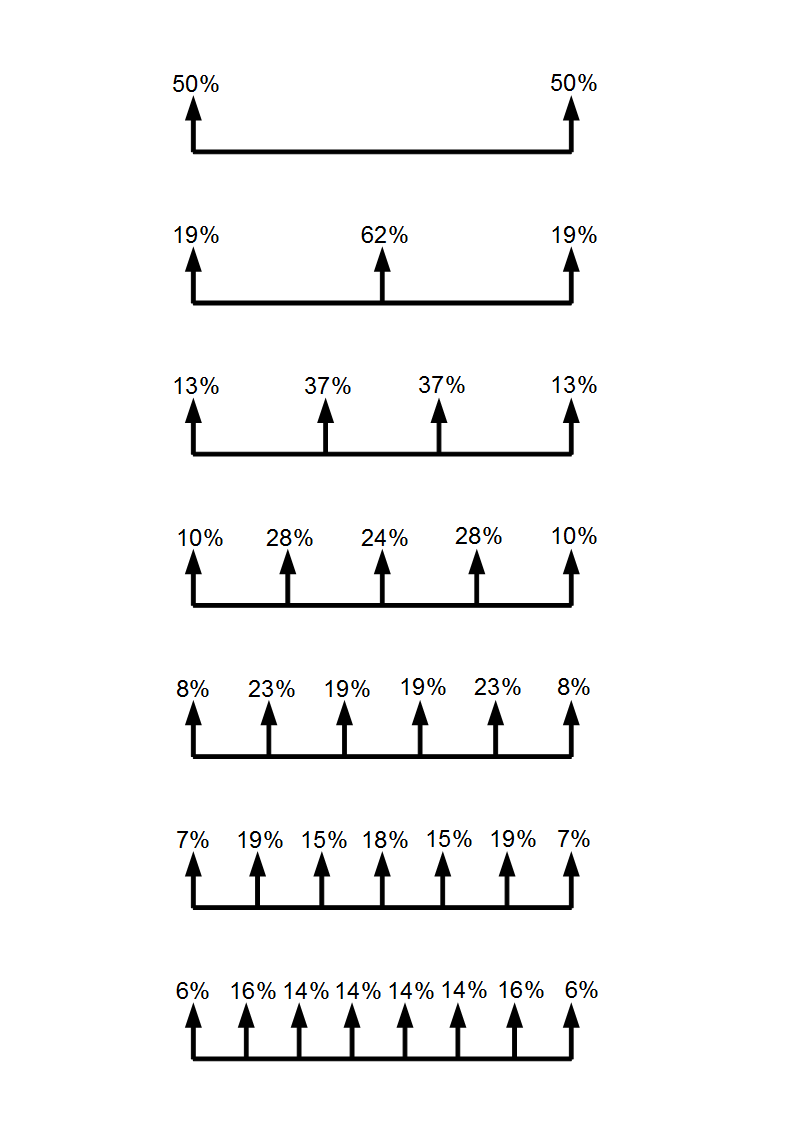
The reason this didn’t work in our imaginary scenario is due to multi-point beam load calculations that he failed to account for. The rigger in this case incorrectly assumed that the three motors would share the load between them equally and didn’t take into account the Three Moment Theorem. This is a very complex formula, however to simplify matters, we have illustrated simplified various rigs below and shown the various loads as percentages of the entire load at each point.
As you can see from the top image with two points, each point carries 50% of the load. If you look at the one below with 3 points you will see that the centre point supports 62% of load and outer points only support 19% of the load. Applying that to what happened to our rigger:
Load = 1,300Kg
Each Outer Point = 0.19 x 1300 = 247Kg per point (19% of the load)
Centre Point = 0.62 x 1300 = 806Kg on centre point (62% of the load)
As you can see, the 500Kg centre point was overloaded at 806Kg and thus collapsed. What the rigger should have done is put up 2 extra motors:
Load = 1,300Kg
Each Outer Point = 0.13 x 1300 = 169Kg per point
Centre Points = 0.37 x 1300 = 481Kg per point
For our scenario, ideally the rigger should use 5 points to give himself a larger margin of error, as with 4 points there is only a 19Kg margin on the centre points.